Benefits of Learning Animation at the Best CBSE School in Kanpur
Most parents think animation is something children watch. But education today is proving it is something they should make. This blog tells the story of what animation learning actually does to a child through the lens of a student who discovers that they are more creative than anyone told them.
Introduction
Aryan was nine years old and convinced he was not creative. His older sister painted. His cousin wrote poetry. At every family gathering, someone had a talent to display. Aryan had good marks.
When relatives asked what he was good at, his mother would say, “Studies” and Aryan would smile and say nothing. Then one afternoon, he saw the privilege of studying in the best CBSE School in Kanpur. His school introduced something new. The teacher walked into Std III without a textbook. She opened a laptop, connected it to the smart board, and showed the class a thirty-second animation. A small character walked across, stumbled, got up, and kept going. The whole class laughed. Then she said something that Aryan remembered for years afterwards:
"One of you made this. And the rest of you are going to learn how."
That was the beginning of the Animation Masterclass at Allenhouse Public School Panki. And for Aryan, and for many children like him, it was the beginning of something fun and promising.
7 Benefits of Learning Animation at the Best CBSE School in Kanpur
Let’s walk you through Aryan’s story ahead so that you can witness how animation at Allenhouse Panki benefitted him and others like him.
1. Creativity Boost
The most damaging idea in education is that creativity belongs to certain children and not others. It does not. Creativity is a skill. It can be built, developed, and strengthened through the right environment, the right tools, and enough time to practice. The problem is that most schools never give children the environment, the tools, or the time.
Allenhouse Public School Panki does. As the best CBSE school in Kanpur for creative learning, the school has built its Animation Masterclass around a simple but powerful belief: every child has the capacity to make something original. The school's job is to give them the means.
What makes this programme genuinely different is how it is structured. It does not drop students into complex software and hope for the best. It builds from the ground up:
- Starting from class III, children learn the basics of graphic design. They explore colour theory, digital drawing, and basic poster making.
- By Class VIII, they are building 3D models, applying textures, and rendering animation sequences.
Every stage is purposeful. Every year adds something real to what came before.
Aryan, who had spent eight years believing creativity belonged to other people, made his first digital design in his class. It was a poster. Rough, a little misaligned, slightly too many fonts but he loved it immediately as the teacher praised his thought behind it.
2. Progressive Journey: Stage by Stage
Here is what the Animation Master Class actually looks like from Class III to Class VIII and why the structure matters as much as the content.
- Class III - Graphic Design Fundamentals: As discussed before, students begin with colour, shape, and composition. They learn basic digital drawing tools and create simple posters and greeting cards. Nothing complex or intimidating. Just the foundational understanding that digital tools can make things, and that they are the ones making them.
- Class IV - Photo Editing Basics: Students learn to adjust brightness, contrast, and colour. They work with layers for the first time. It is a concept that sounds technical but becomes intuitive quickly. They create digital collages that merge multiple images into a single narrative. In one afternoon, a photograph of a mountain and a photograph of a cat become something new. Children find this kind of discovery genuinely thrilling.
- Class V - Advanced Graphic Design: Students move into branding and advertising. They explore logo design, banner creation, and event posters. Typography and colour theory are introduced formally. Students begin to understand that design communicates before language does. Those fonts have personality. That the space between things matters as much as the things themselves.
- Class VI - Photo Manipulation: Advanced editing, professional retouching, and creative manipulation, blending photographs into compositions that feel like paintings. Special effects and filters are introduced as storytelling tools, not decorations. Students begin to understand that images are not documents of reality. They are arguments.
- Class VII - Camera Handling and VFX: This is the year that consistently produces the most visible excitement. Students learn cinematography fundamentals: camera angles, movements, the language of visual storytelling. Green screen and chroma keying introduce the mechanics behind what they have seen in films for years. Visual effects basics teach them that the impossible on screen is simply a specific kind of deliberate, patient digital work.
- Class VIII - 3D Modelling and Animation: The final stage. Students build objects and characters in three dimensions, apply textures and lighting to make them feel real, and animate them. They render their work. For many students, watching their own 3D model move for the first time is the single most memorable moment of their school creative education.
Each year, the programme in an English medium school in Kanpur builds exactly what the previous year prepared the student for. Nothing arrives before its time and nothing is skipped. Aryan went through this interesting journey too, learning it all little by little, yet so much.
3. Mastering the Use of Real Tools
Here is something the best CBSE School in Kanpur gets right that most schools with animation or art programmes get wrong. The software matters. At APS, our students work with
- Blender
- After Effects
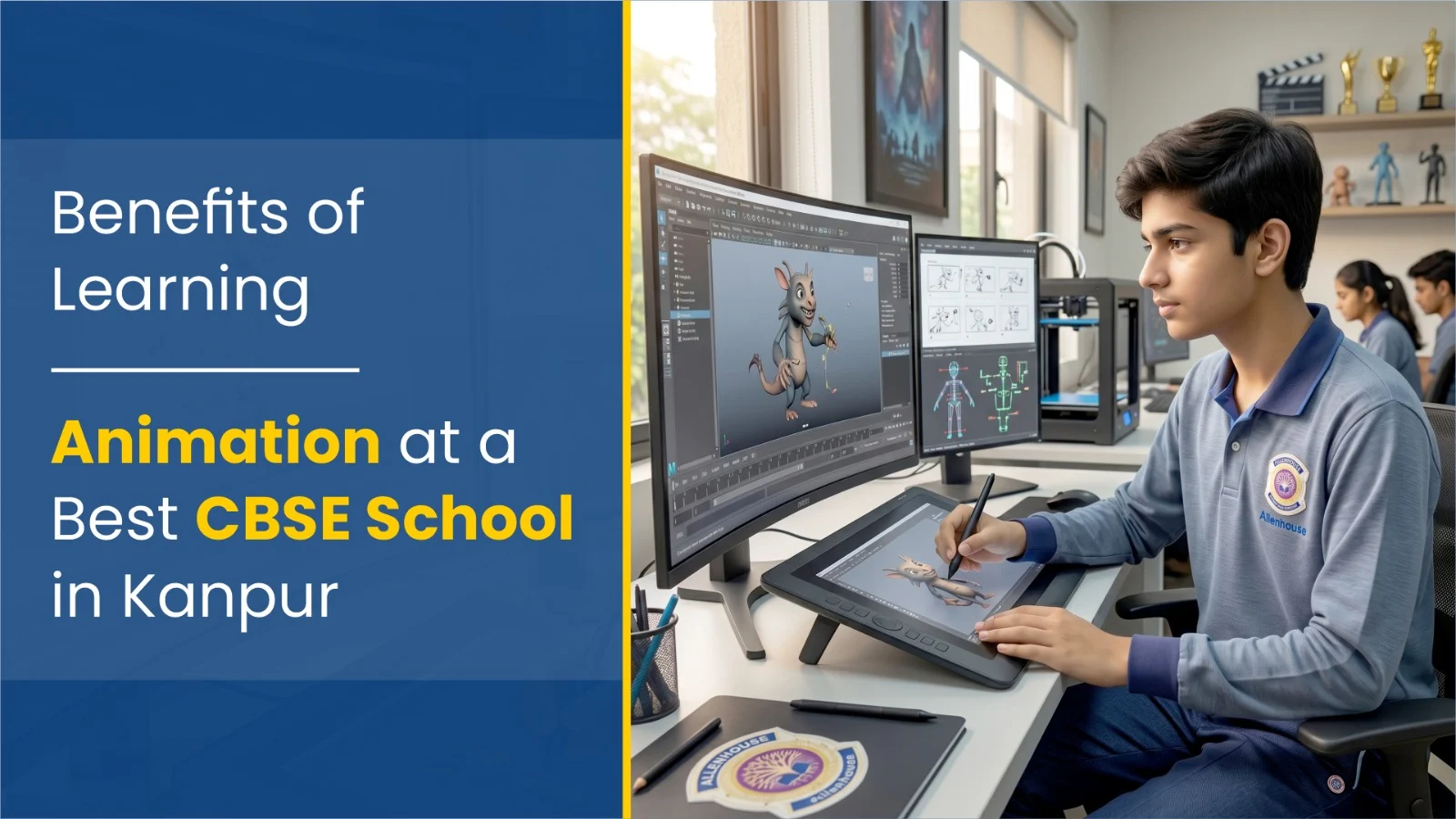
- Photoshop
- Premiere Pro
These are the actual tools used by working animators, filmmakers, and digital designers in studios around the world, not simplified educational versions.
When a child sits down with Blender in Class VIII and builds a 3D model that exists in a rendered digital space, something shifts in how they relate to technology. They stop being consumers of what other people built. They become someone who builds. For a reputed CBSE school in Kanpur, the decision to teach professional-grade software is a significant one. It says that we believe our students are capable of handling real things. That belief, communicated through the tools themselves, lands differently than a motivational speech.
Aryan spent three weeks in Class VIII learning Blender before anything he made looked the way he intended. He did not quit. That surprised him. He had quit piano after two lessons. But this was different. He could see the gap between what he imagined and what he was producing. And the gap kept getting smaller. That visible progress was motivating in a way that marks on a test paper had never quite managed.
4. The Overall Positive Impact on Studies
By Class V, Aryan's science teacher noticed something. His answers were different. When asked to explain how photosynthesis worked, he did not write a list. He described the process as if it were happening frame by frame. There were systematic details around the light hitting the leaf, chlorophyll absorbing it, energy being stored. He was, without realising it, thinking like someone who had spent two years learning to communicate ideas visually.
This is one of the most consistently observed benefits of animation learning and one of the least expected. Animation forces a child to understand something deeply before they can represent it.
- You cannot design a poster about a concept you do not understand.
- You cannot manipulate an image to tell a story you have not grasped.
- You cannot build a 3D scene around an idea that remains abstract in your mind.
The requirement to show understanding rather than state it produces a quality of comprehension that reading and writing about a topic rarely achieves. The result is students who approach new material and instinctively ask, “how would I show this?”. That question, asked sincerely, is one of the best learning habits a school can develop.
5. Improving Communication
In Class VII, learning camera angles and visual storytelling, Aryan discovered something unexpected: He could write.
The cinematography unit required students to plan their shots before they filmed. To write out what would happen, in what order, from what angle, and why. Aryan wrote his shot list and kept going. Two pages became four. The characters in his sequence started having motivations that went beyond the assignment brief.
This is one of the less visible but genuinely significant benefits of the programme. Visual storytelling develops
- narrative thinking
- language precision
- empathy
- ability to imagine a different perspective
- inhabit ideas convincingly
A student planning a green screen sequence has to think about character, context, and consequence. These are the same cognitive moves that good writing requires.
6. The Collaboration Nobody Talks About
By Class VII, Aryan was working on a group VFX project. His team had four students. One had a better eye for camera angles than anyone else in the class. One was quiet in every lesson except this one, where she had more ideas about the green screen sequence than the group could use. One was meticulous about the VFX layering, watching each frame and insisting on adjustments that nobody else initially noticed but that everyone agreed, when done, made the whole thing feel right. And Aryan was the one who could hold all their ideas together and figure out which ones served the story. Nobody assigned these roles. The project required them, and the students found them.
Animation projects at the best CBSE School in Kanpur are exactly this kind of collaborative experience. Multiple disciplines, multiple roles, one shared output that is only possible when everyone contributes something distinct. The teamwork is built into the structure of the work itself.
7. The Portfolio That Opens Doors
Aryan is fifteen now. He has a portfolio. Not a folder of test papers. A collection of things he made: from his first digital poster in Class III to the 3D animated sequence he rendered in Class VIII. Six years of work, each piece more sophisticated than the last, all produced using professional software.
This is the practical, concrete benefit of animation learning in school. A portfolio of real work, built over years using professional tools, is a demonstration of capability rather than a claim about it. And in a world where showing what you can do matters as much as what you scored, that distinction is significant.
Conclusion
What if your child is Aryan? Intriguing right? Most children do not arrive at school already knowing what they are good at. Many carry a quiet belief that creativity is something other children have. The best CBSE school in Kanpur challenges that belief.
At Allenhouse Public School Panki, through our Animation Masterclass, we give children professional tools, a six-year structured curriculum and the repeated experience of producing something original. In the process every child discovers their skills. And that discovery of their own creative capability, evidenced by things they actually made is one of the most valuable things any school can offer.
That’s APS Panki. That’s our goal for thousands of students every year!
Your Queries Answered
1. What animation skills do students learn at Allenhouse Public School Panki?
Students learn 3D animation, motion graphics, digital art, video editing, character design, and visual storytelling using professional software like Blender, Photoshop, After Effects, and Premiere Pro.
2. How does animation learning help students academically at the best CBSE School in Kanpur?
Animation improves understanding, creativity, focus, and problem-solving because students learn by creating visual explanations of concepts instead of only memorising them.
3. Is animation learning suitable for non-artistic children?
Yes. The programme is designed for beginners and develops creativity gradually through structured projects and guided learning.
4. Why is Allenhouse Panki known for creative education in Kanpur?
Allenhouse Panki offers structured animation training with professional tools, specialist faculty, and project-based learning integrated into academics.
5. How does an animation portfolio help students later?
A portfolio gives students real project work they can use for college admissions, competitions, internships, and future creative or technology careers.