English Medium School in Kanpur for Coding Skill Development: A Complete Guide for Parents
Coding is no longer a specialised skill for future engineers. It is foundational literacy for the world your child is growing up in. This guide helps parents in Kanpur understand what real coding education looks like, why it matters and why an English medium school in Kanpur delivers it better than most.
Introduction
You must have noticed it too: Your child uses a smartphone better than most adults in the room. Finds YouTube tutorials for things nobody taught them. Figures out games and apps within minutes of downloading them. So the assumption follows naturally: My child is good with technology. We are covered. Here is the gap in that thinking. Using technology and understanding technology are completely different things. One makes your child a consumer of what someone else built. The other makes them someone who can build things themselves. Coding is the bridge between those two positions. And the English medium school in Kanpur that teaches it well is not just adding a skill to your child's profile. It is changing how they think.
This is a complete guide for parents who want to understand what real coding education looks like, what questions to ask and why Allenhouse Panki has become the school in Kanpur that takes this most seriously.
What Coding Teaches and Why It Is Not Just About Computers
Before getting into what Allenhouse Panki offers, it is worth clearing up the most common misconception about coding education. Coding is not primarily about making children into software engineers. Most children who learn to code will not write software professionally. That is fine. Because what coding actually develops is something far more transferable.
Logical thinking. The ability to break a complex problem into smaller, manageable steps. The habit of testing an idea against reality and adjusting when it does not work. Precision in communication because a computer does exactly what you tell it, which means you have to learn to say exactly what you mean. These are thinking skills. And they are useful in medicine, in law, in business, in design, in every field that will matter in the decades ahead.
A top CBSE school in Kanpur that understands this teaches coding as a thinking discipline first and a technical skill second. That distinction determines everything about the quality of the programme.
What Real Coding Education Looks Like in an English Medium School in Kanpur
Not all coding programmes are equal. Some are genuinely transformative. Others are mostly impressive-sounding additions to a school brochure. Here is how to tell the difference when you look through the offerings of an English medium school in Kanpur.
Real coding education looks like this:
- Children write actual code that produces actual results they can see and interact with
- Programming concepts are introduced progressively, building genuine fluency over the years
- Coding is connected to real projects (games, apps, robots, animations) that give the learning purpose
- Failure and debugging are treated as normal parts of the process, not embarrassing mistakes
- Children develop the confidence to try something they have not been shown before
Watch out for programmes that:
- Treat coding as a single class per week with no connection to anything else
- Focus entirely on drag-and-drop tools without introducing actual programming languages
- Measure success by completion of modules rather than demonstrated capability
- Have no dedicated infrastructure, no proper labs, no specialist teachers, no real equipment
- Exist on the prospectus but have limited actual presence in daily school life
Allenhouse Panki sits firmly in the first category. Here is what that looks like specifically.
How Allenhouse Panki Builds Coding Skills
Here is what we do at Allenhouse to build strong coding skills:
The Coding and Robotics Academies
The most powerful thing about the Coding and Robotics Academies at Allenhouse Panki is simple: Children can see their code do something.
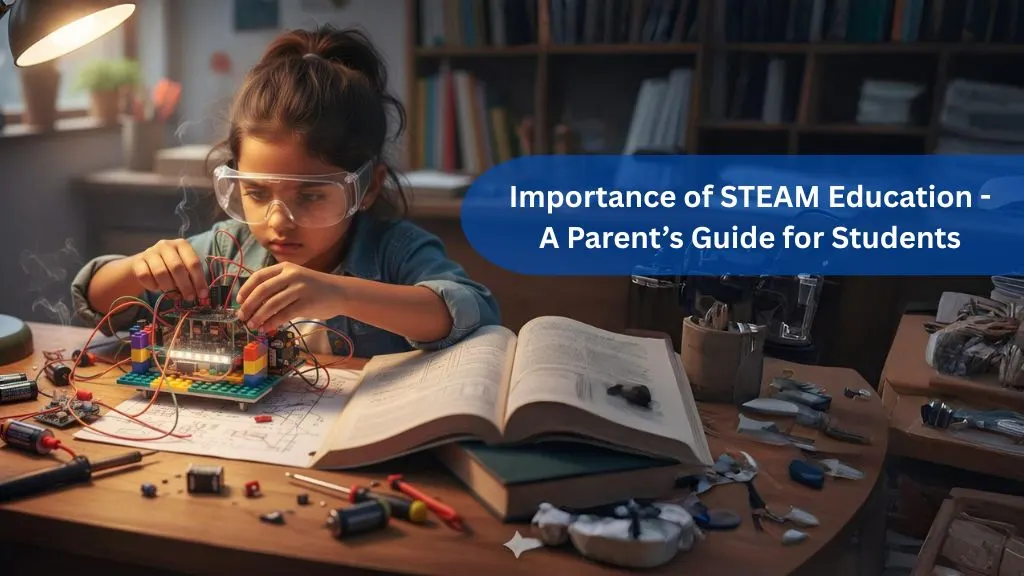
They build a robot. They write the code that controls it. They run it, watch what happens, figure out why it did not do what they intended, fix the code and try again. That loop (write, test, fail, debug, improve) is how professional developers work. It is also one of the most effective learning processes ever documented.
Coding taught through robotics is coding that sticks. Because it is never abstract. Every line of code has an immediate, visible consequence. Children understand what they are doing and why it matters and that understanding is the foundation of genuine capability.
- Students build and program real robots, not simulations
- Coding is learned in context, connected directly to engineering outcomes
- The debugging process develops resilience and analytical thinking simultaneously
- Robotics competitions give children goals that make the learning feel meaningful
- Technical confidence built through our academy carries across every STEAM subject
Animation and Creative Coding
There is a whole dimension of coding that most schools either ignore or treat as less serious. Creative coding. The use of programming in animation, game design, interactive media and visual storytelling.
At Allenhouse Panki, the animation masterclass runs alongside the robotics programme and uses industry-standard software — Blender, Photoshop and Premiere Pro — to teach children 3D modelling, animation and digital production.
This matters for two reasons.
First, it opens coding education to children who are creatively oriented but might not immediately identify with engineering. A child who loves storytelling and visual art discovers, through animation, that coding can be a creative tool as much as a technical one. That discovery changes their relationship with the subject entirely.
Second, the creative technology industry is one of the fastest-growing sectors in the world. Film, gaming, digital media and UX design: all of these fields sit at the intersection of coding and creativity. Children who develop both are genuinely rare. And genuinely valuable.
- 3D modelling and animation training uses the same software that industry professionals use
- Creative coding connects technical skill to artistic expression, opening the subject to a wider range of learners
- Design thinking developed through animation transfers directly into problem-solving across disciplines
- Children build an actual portfolio of creative work, not just a record of modules completed
Project-Based Learning for Coding With a Purpose
The fastest way to kill a child's interest in coding is to teach it in isolation. Syntax rules, abstract exercises and theoretical concepts with no visible application. Children do not engage with things that feel purposeless.
Allenhouse Panki's pedagogy is built around project-based learning. Coding is always taught in the context of building something. A working programme. A functioning robot. A 3D animation. An interactive tool. The project gives coding a reason to exist, which gives the child a reason to persist through the difficult parts.
- Every coding unit is anchored to a real project with a visible outcome
- Interdisciplinary projects connect coding to science, mathematics, arts and design simultaneously
- Children present their projects, which develops communication skills alongside technical ones
- Project portfolios built over school years demonstrate real capability, not just course completion
The best school in Kanpur for coding education is one where children always know why they are learning what they are learning.
Dedicated Infrastructure: the Facilities That Make It Possible
Great coding education needs the right environment. Without proper infrastructure, even the best curriculum produces limited results. Allenhouse Panki has invested seriously here.
- Modern computer labs equipped for current programming languages, animation software and digital project work
- A dedicated Robotics Academy with the tools and components for real robot-building
- Smart classrooms that support interactive, technology-integrated instruction
- Advanced science laboratories that connect coding education to broader STEAM learning
- Reliable, high-quality equipment that children use daily, not just during demonstrations
Questions Parents Should Ask Any School About Its Coding Programme
Before enrolling your child, ask these questions specifically:
About the programme:
- At what age does coding education begin and how does it progress across years?
- What languages and tools are taught and are these industry-relevant?
- Is coding taught as a standalone subject or integrated across the curriculum?
About the infrastructure:
- Can I see the computer labs and robotics facilities during my visit?
- How many students share each workstation or piece of equipment?
- Is the software used current and updated regularly?
About the teachers:
- Are coding and robotics taught by specialist teachers with real technical backgrounds?
- How is teacher development supported in this area?
About outcomes:
- What have students built or produced through the coding programme?
- Do students participate in coding competitions or external challenges?
- What does a child's coding portfolio look like by the time they complete school here?
Allenhouse Panki has confident, specific answers to every one of these. That confidence is itself informative.
Why STEAM Education Is the Right Framework for Coding
A coding programme that sits alone, disconnected from science, mathematics, engineering and arts, produces narrower results than one embedded in a broader STEAM education framework. Here is why. Real-world coding challenges are never purely technical. They involve understanding a problem domain (science, business, design), communicating with people who are not programmers (arts, language), working within constraints (engineering, mathematics) and creating solutions that are both functional and usable (design thinking).
STEAM education teaches coding in exactly this broader context. Science provides the problems worth solving. Mathematics provides the logical foundation. Engineering provides the design and build methodology. Arts provide creative thinking and communication skills. Technology, including coding, provides the tools.
At Allenhouse Panki, these are not five separate subjects. They are five lenses through which every significant learning experience is approached. That integration is what makes the coding education here genuinely powerful rather than just technically competent.
Conclusion
Choosing an English medium school in Kanpur that takes coding seriously is one of the most forward-thinking decisions a parent can make right now. It is not because every child who learns to code will become a software engineer. But because the thinking skills coding develops are skills that compound across a lifetime regardless of what career a child eventually chooses. They master logical reasoning, systematic problem-solving, creative application of technical knowledge and resilience in the face of failure.
Allenhouse Panki has built a coding education programme that is genuine, comprehensive and deeply integrated into a broader STEAM education framework. The Robotics Academy, the animation masterclass, the project-based curriculum and the dedicated infrastructure combine to create something that most schools in Kanpur simply do not offer.
As the best school in Kanpur for STEAM-oriented learning, Allenhouse Panki is preparing children for the world that actually exists. Not the one from the last curriculum update.
Your Queries Answered
1. At what age should my child start learning coding at a school in Kanpur?
Coding can start in primary school with simple, age-appropriate tools. By middle school, students can move to real programming and projects.
2. How is STEAM education different from regular science and computer education?
STEAM connects subjects like science, technology and maths instead of teaching them separately. This helps students understand concepts better and apply them together.
3. What makes Allenhouse Panki a strong school in Kanpur for coding skill development?
It offers coding, robotics and project-based learning with proper labs and trained teachers. Students work on real projects, not just theory.
4. Does coding education help with competitive exams and college admissions?
Yes. Coding improves logical thinking and problem-solving, which helps in exams. It also strengthens college applications, especially for tech-related fields.
5. How do I assess a school's coding programme during an admission visit?
Visit the labs, see student projects and ask what students have built. Check if teachers are trained and if coding is taught regularly, not occasionally.