In a parent’s life, choosing the best school in Kanpur for their child is one of the most important decisions. With so many options in Kanpur, what do you actually look for? This blog simplifies it for you as an honest, practical guide.
Introduction
Your neighbour swears by one school. The colleague insists on another. Somewhere in the middle of it all, you are trying to make a decision that will influence your child's next twelve to fifteen years. It is a lot! Therefore, when choosing the best school in Kanpur for your child, find the right fit. It should be one that genuinely prepares your child for the world they will actually live and work in.
11 Things to Look Out for in Hunt for the Best School in Kanpur
Your search made easier! Yes, here are eleven points that will help you pick a good school and drive away all confusion:
7 Main Things With No Compromise Upon
So, we will bifurcate the eleven things into two categories. The first one has 7 points that can never be ignored. The second category also has more.
1. A Curriculum That Prepares Children for the Real World
The first question isn't which board. It's what philosophy sits behind the learning. A CBSE affiliated school in Kanpur follows a nationally recognised curriculum with strong academic foundations. It is one that keeps competitive exams like JEE and NEET within reach while building the conceptual depth that higher education demands. But the best schools go further than syllabus delivery. They build thinking skills alongside content knowledge. They ask children to apply what they've learned, not just remember it.
CBSE provides a strong, nationally standardised academic foundation
Look for schools where learning involves application, not just memorisation
Assessment methods should reward thinking, not just recall
Teachers should be facilitating understanding, not just delivering content
A school that builds curious, independent thinkers produces graduates who adapt to anything
At Allenhouse, CBSE affiliated school in Panki Kanpur, the curriculum is built around this understanding. Here academics are taken seriously but so is all that happens beyond them.
2. STEAM Education Because the Future Belongs to Children Who Can Build Things
This is the one most parents don't ask about nearly enough. However, it might be the most important differentiator between a good school and a great one.
STEAM education stands for Science, Technology, Engineering, Arts, and Mathematics. It is how schools prepare children for a world shaped by technology and creativity. That process of building, failing, learning, and trying again is arguably the most useful thing a child can learn in school. And it is exactly what aCBSE affiliated school in Panki Kanpur like Allenhouse makes possible.
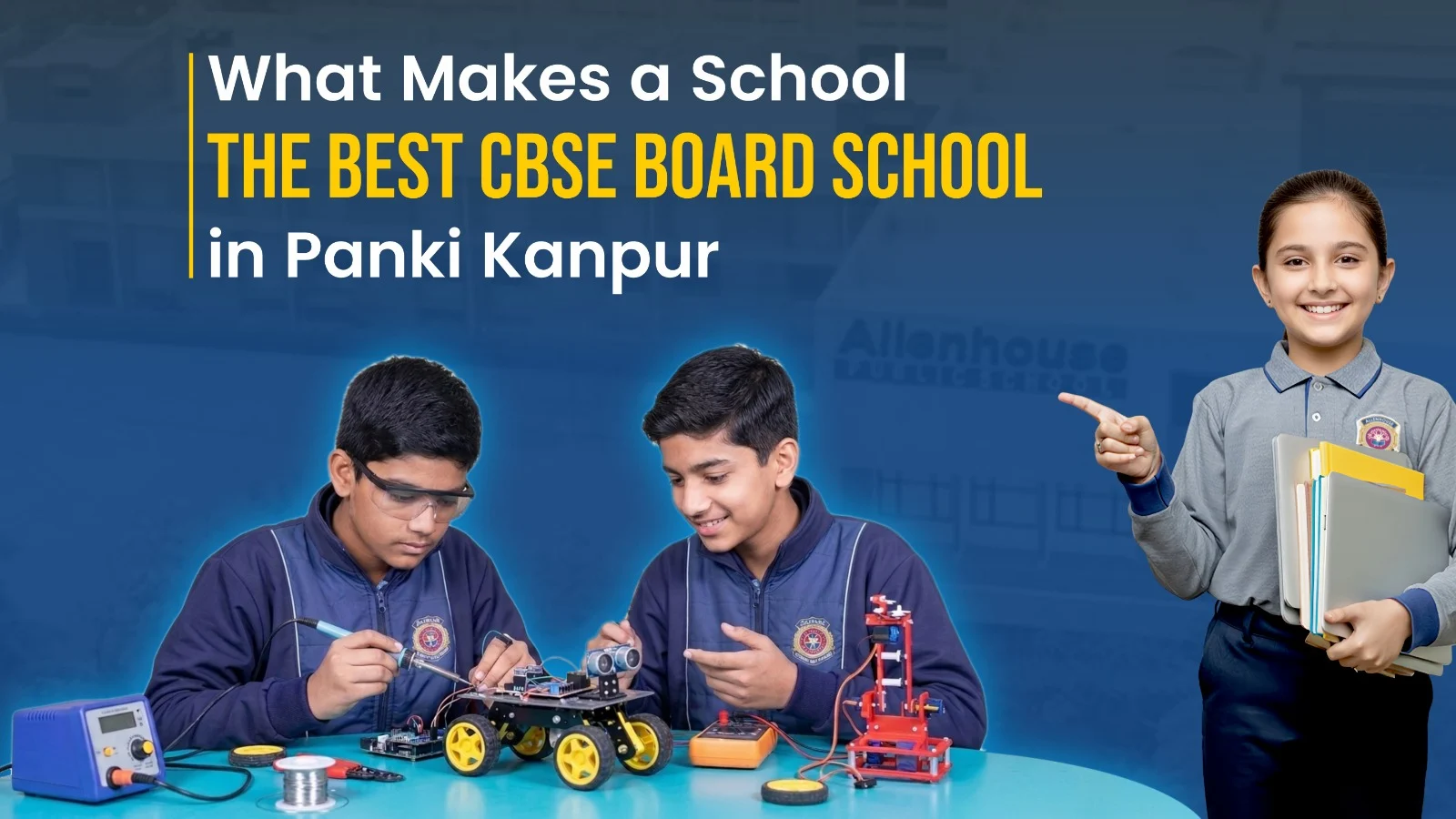
At Allenhouse Panki, this isn't a brochure claim. It's built into the school day through dedicated programmes in coding, animation, and robotics that give children the tools to not just understand technology but to create with it.
Coding teaches children to think logically and solve problems systematically. Animation develops creative expression alongside digital fluency. Robotics brings science and engineering to life in ways that no textbook can replicate. Children build things and test them. They watch them fail, figure out why, and try again.
3. Teachers Who Actually Care
Here is something no school brochure will ever tell you. The fanciest building in the world cannot compensate for a mediocre teacher standing in front of your child every morning.
The single biggest factor in how well a child does in school is not the board, not the infrastructure, not even the curriculum. It is the person in the classroom. The one who decides, in that small moment when a child looks confused, whether to stop and help or move on because there is a syllabus to finish.
A top rated school in Kanpur invests in its teachers. Really invests. Not just in their subject knowledge but in their ability to see the child, not just the student.
When you visit any school, here is what to actually pay attention to:
How long have the teachers been there? High turnover is a quiet red flag that most parents miss completely
Do the staff look genuinely interested in the children around them, or just doing a job?
Does the school invest in ongoing teacher training? A teacher who keeps learning keeps getting better
What is the teacher-to-student ratio? This is the difference between individual attention and falling quietly behind
At Allenhouse Panki, teachers are chosen and supported with the whole child in mind. Not just the student who shows up for the annual exam. The whole person.
4. A Place Where Children Actually Want to Show Up
A child who dreads school learns less than one who looks forward to it. That is not a controversial statement. It is just how human beings work.
So when you visit a school, forget the brochure for a minute. Just walk in and pay attention to what you feel.
Do the children look engaged or just present? Do they seem comfortable around their teachers or a little guarded? Is there real energy in the building or just the sound of people waiting for the day to end?
These things are hard to fake. And they tell you more about daily school life than any prospectus ever will.
As a trusted English medium school in Kanpur, Allenhouse Panki has built an environment where children feel safe, seen, and genuinely challenged. And on the question of safety, here is what to ask specifically when you visit:
How does the school handle bullying? The answer should be specific, not vague
What support exists for a child who is struggling, academically or personally?
Is emotional wellbeing treated as seriously as academic performance?
Beyond safety, the co-curricular programme matters more than most parents realise:
Sports, performing arts, and student leadership build confidence that classrooms alone cannot
Every child needs something at school that is theirs, not just the academically strongest ones
Resilience is built in these spaces, quietly, through wins and losses and trying again
The culture at Allenhouse Panki is one where every child has a real reason to show up fully. That is rarer than it sounds.
5. Value That Lasts a Lifetime
Nobody enjoys talking about fees. But let us be honest about it because it matters.
The right school is not the most expensive one. It is the one that delivers genuine, lasting value at a cost your family can actually sustain. Not just in year one. Across twelve years. Because a school that stretches your finances to the edge every quarter creates stress at home. And children feel that stress, even when you think they do not.
When comparing schools, look at the full picture:
What does the fee actually include?
What are the costs that do not appear in the headline figure, such as uniforms, books, activity fees, and transport?
What is the actual return on this investment in terms of your child's real development and future readiness?
Allenhouse Panki offers strong academics, dedicated STEAM programmes including coding, animation and robotics, and genuine holistic development, all at a fee structure built around being accessible to Kanpur families. There is value, not just a price tag.
6. Parent-School Communication and Transparency
Here is something most parents only realise matters after they have already picked a school.
You are going to have questions. Concerns. Moments where something feels off and you need a real conversation with someone who actually knows your child. The question is whether the school makes that easy or complicated.
A school that communicates openly with parents is a school that has nothing to hide. One that doesn't is telling you something important without saying a word.
When you visit, ask specifically:
How does the school communicate academic progress beyond the report card?
Is there a clear, accessible process for raising a concern without it becoming a big production?
Do parent-teacher meetings happen regularly or only when something goes wrong?
Are parents treated as partners in their child's education or just as fee-paying customers?
At Allenhouse Panki, parents are kept genuinely informed. Because a child does better when the school and the family are working in the same direction.
7. Track Record and Reputation in the Community
Reputation is not everything. But it is not nothing either.
A school that has been consistently producing well-rounded, capable, confident graduates over many years is doing something right. And the best way to find that out is not from the school itself. It is from the parents and students who have already been through it.
Talk to people in the community. Ask former students what they actually remember about their school years. Ask current parents what surprised them after their child joined. The answers will tell you far more than any open day presentation.
Here is what to look for:
Do graduates of the school go on to strong colleges and careers?
Do current parents recommend the school genuinely, not just out of habit?
Has the school maintained its standards over time or is it running on old reputation?
Is the school known in Kanpur for the right reasons, academics, values, student development?
4 Things That Value As Well
Once the school has the above mentioned seven aspects, watch out for the following points too:
Security Measures: Prioritise schools with robust safety. This includes CCTV surveillance and well-trained security guards.
Campus Facilities: Visit the campus to check for smart classrooms, well-equipped science labs, libraries, and adequate sports facilities
Commute Time: Choose a school close to your home to minimise travel stress for your child.
Transportation Services: Evaluate the school bus service's safety and coverage. GPS enabled
Conclusion
There is no single right school for every family. But there is a right one for yours. The one that fits how your child learns. It must reflect what your family values. It should make you feel after the visit that your child is going to be genuinely good here.
The best school in Kanpur takes academics seriously. They build real skills through STEAM education, employ teachers who actually care, create a culture where every child belongs, and deliver value that outlasts the school years themselves.
Allenhouse Panki does all of that. Go visit. Ask the uncomfortable questions. Trust what you see. The school will show you what it is made of.
Your Queries Answered
1. How do I choose the best school in Kanpur for my child?
Check board affiliation, location, and budget first. Then visit the school, observe classes, and speak to parents. Focus on teaching quality, student support, and overall environment.
2. Why is STEAM education important when choosing a school in Kanpur?
STEAM builds skills like problem-solving, creativity, and tech awareness. These are essential for future careers and real-world learning.
3. What makes Allenhouse Panki a trusted English medium school in Kanpur?
It offers a strong CBSE curriculum, STEAM programmes, experienced teachers, and a supportive environment focused on overall development.
4. Is a CBSE affiliated school in Panki Kanpur the right choice for my child?
Yes. CBSE provides a solid academic foundation and prepares students for competitive exams, making it a reliable choice for most families.
5. What should I look for during a school visit?
Observe teacher-student interaction, student engagement, and classroom environment. Ask about academics, support systems, and extracurricular activities.